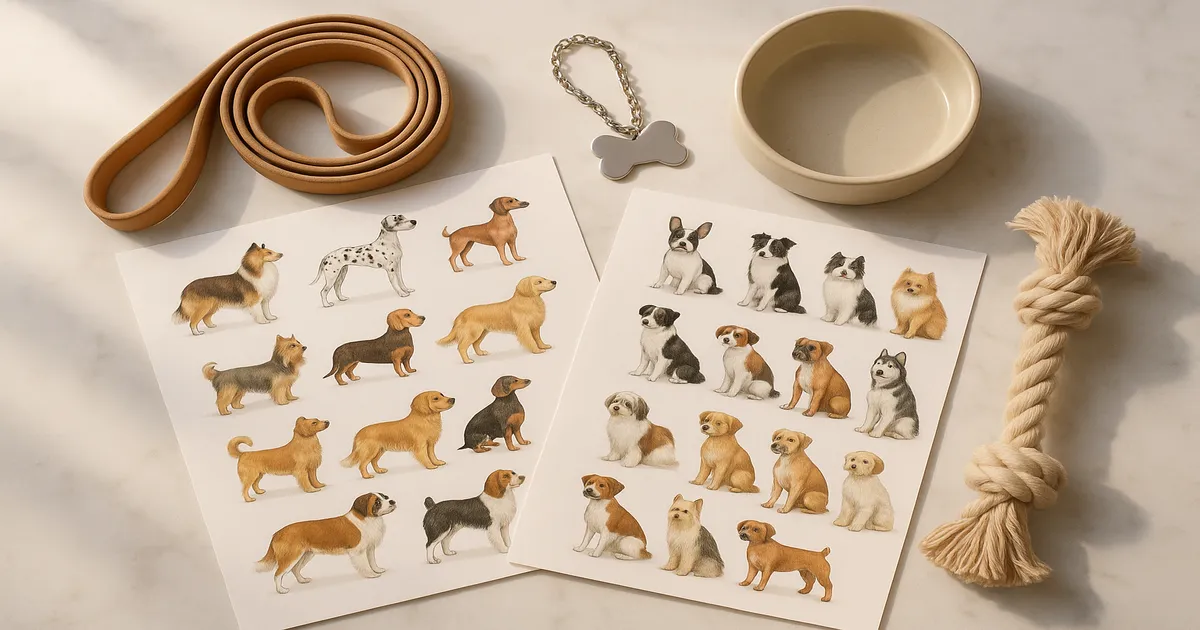
Quick Answer: To find out a dog breed’s name, examine physical traits like coat type, ear shape, body size, and muzzle length — then confirm with a breed ID app like Dog Scanner or a DNA test like Embark. “Can you tell me this dog breed’s name?” is one of the most searched pet questions online, and the answer depends on whether you want a quick guess or a definitive result.
Can You Tell Me This Dog Breed’s Name? Start Here
About 53% of dogs in the U.S. are mixed-breed, which means the dog you’re looking at may not fit neatly into any single category. Even purebreds can look dramatically different depending on age, coat condition, and whether they come from show or working lines. Visual identification is genuinely hard — trained shelter staff get it wrong more often than you’d think.
You have two main routes to an answer:
- Visual clues — coat, ears, tail, size, muzzle, and gait can narrow things down significantly
- Tech tools — AI photo apps give quick results; DNA tests give definitive answers for mixed breeds
The sections below walk through both approaches, then cover the breeds people most commonly can’t identify.
How to Identify a Dog Breed by Appearance
Body Size and Proportion
Size is your first filter. Most breed registries use these rough categories:
- Toy: Under 12 lbs (5.4 kg) — Chihuahua, Pomeranian, Yorkshire Terrier
- Small: 12–25 lbs (5.4–11 kg) — Beagle, French Bulldog, Cocker Spaniel
- Medium: 25–60 lbs (11–27 kg) — Border Collie, Bulldog, Basenji
- Large: 60–100 lbs (27–45 kg) — Labrador Retriever, German Shepherd, Boxer
- Giant: 100+ lbs (45+ kg) — Great Dane, Saint Bernard, Mastiff
Body proportion matters too. Long-bodied, short-legged dogs like the Dachshund and Basset Hound belong to a completely different lineage than square, athletic builds like the Vizsla or Weimaraner.
Coat Type, Texture, and Pattern
Coat is one of the most reliable visual clues:
- Smooth/short: Boxer, Beagle, Greyhound
- Wire/rough: Scottish Terrier, Airedale, Brussels Griffon
- Double coat (dense undercoat): Labrador, Husky, Corgi
- Single coat (no undercoat): Poodle, Maltese, Shih Tzu
- Curly: Poodle, Bichon Frisé, Portuguese Water Dog
- Long and silky: Afghan Hound, Yorkshire Terrier, Irish Setter
Useful pattern terms: merle (mottled patches), brindle (tiger-stripe), piebald (large white patches), sable (dark-tipped hairs), tricolor (black, white, and tan).
Ear Shape
- Erect (pricked): German Shepherd, Siberian Husky, Chihuahua
- Drop/pendant: Basset Hound, Bloodhound, Beagle
- Rose (small, folded back): Greyhound, Whippet, Bulldog
- Button (folded forward at tip): Jack Russell Terrier, Pug
- Semi-erect: Collie, Shetland Sheepdog
- Cropped: Doberman, Boxer, Great Dane (surgical alteration)
Muzzle Shape
Muzzle shape narrows the field fast:
- Brachycephalic (flat-faced): Bulldog, French Bulldog, Pug, Boxer, Shih Tzu
- Dolichocephalic (long, narrow): Greyhound, Borzoi, Collie, Saluki
- Mesocephalic (medium): Most breeds — Labrador, German Shepherd, Beagle
Tail and Gait
Tail type adds another layer of detail. A curled tail over the back points to Akita, Chow Chow, or Pug. An otter-like tail (thick at the base, tapering toward the tip) is a Labrador hallmark. A plumed, feathered tail suggests Golden Retriever or Irish Setter.
Gait is worth watching too. Herding dogs move with a low, stalking crouch. German Shepherds have a long, ground-covering trot. Sighthounds like the Greyhound and Whippet show a deep chest, tucked abdomen, and arched loin that’s unmistakable even at a distance.
Best Tools to Answer “Can You Tell Me This Dog Breed’s Name?”
AI Photo Apps
| Tool | Type | Accuracy | Best For |
|---|---|---|---|
| Google Lens | AI image recognition | Moderate–High | Quick free check |
| Dog Scanner App | Dedicated breed ID | High (350+ breeds) | Casual ID, purebreds |
| AKC Breed Identifier | Photo upload | Moderate | AKC-recognized breeds |
| Embark DNA Test | DNA-based | Very High (350+ breeds) | Mixed breeds, health info |
| Wisdom Panel | DNA-based | Very High (350+ breeds) | Mixed breeds, budget option |
Google Lens is free and surprisingly capable — open your camera app and tap the search icon. For a more dedicated experience, the Dog Scanner app has a larger breed database and is worth downloading if you regularly encounter unknown dogs.
The catch with all photo tools: they struggle with mixed breeds and unusual lighting. Treat app results as a starting point, not a verdict.
DNA Testing for Definitive Results
If you genuinely need to know — for health planning, behavioral expectations, or legal reasons — a DNA test is the only truly reliable answer. Embark screens for 350+ breeds and flags over 250 genetic health markers. Wisdom Panel is a solid, slightly more affordable alternative with comparable breed coverage.
Both require a simple cheek swab mailed to a lab. Results typically arrive in 2–4 weeks.
Other Resources Worth Knowing
The AKC’s complete breed list with photos is genuinely useful for visual comparison. Reddit’s r/WhatIsThisDog community is surprisingly accurate for crowd-sourced opinions. Your vet can also make an educated guess based on physical structure — it’s free and worth asking.
The Most Commonly Misidentified Dog Breeds
Mixed-Breed and Designer Dogs
Because roughly 53% of U.S. dogs are mixed-breed, they’re statistically the most likely answer when someone asks “can you tell me this dog breed’s name?” Designer dogs like Goldendoodles and Labradoodles add another layer of confusion — puppies from the same litter can look completely different from one another.
Pit Bull-Type Breeds
“Pit Bull” isn’t a single breed. It’s a loose umbrella term applied to several distinct breeds and countless mixes. Visual misidentification here has real consequences, including breed-specific legislation (BSL) that can affect where you’re allowed to live with your dog.
Other Frequently Confused Breeds
- Siberian Husky vs. Alaskan Malamute — Malamutes are larger and heavier-boned; Huskies more commonly have blue eyes
- Greyhound vs. Whippet — Whippets are smaller (25–40 lbs / 11–18 kg) with a slightly less extreme build
- Shih Tzu vs. Lhasa Apso — Lhasas have a longer muzzle and were bred as guard dogs, not companions
- Belgian Malinois vs. German Shepherd — Malinois are leaner, lighter, and significantly more intense in drive
Labrador Retriever: Full Breed Profile
Origin and History
Despite the name, Labs originated in Newfoundland, Canada — not Labrador. They were working dogs for fishermen, bred to retrieve nets and lines from frigid Atlantic waters. English aristocrats imported them to Britain in the early 1800s and refined the breed into what we recognize today. The AKC recognized the Labrador Retriever in 1917, placing them in the Sporting Group.
Two distinct types exist: the English (Show) Lab — stockier, broader-headed, and calmer — and the American (Field) Lab — leaner, longer-legged, and higher energy. Both are officially the same breed, but the behavioral differences are real and worth knowing before you adopt.
Temperament and Training
Labs are famously friendly, outgoing, and gentle — and that reputation is well-earned. Stanley Coren ranked them 7th in working and obedience intelligence in The Intelligence of Dogs. They’re among the most food-motivated breeds on earth, which makes reward-based training genuinely enjoyable. Short, positive sessions with high-value treats work exceptionally well; Labs respond poorly to harsh corrections and don’t need them.
The flip side is that Labs under three years old are essentially perpetual puppies: exuberant, mouthy, and easily bored. Redirect chewing behavior early and consistently with appropriate outlets.
Exercise Requirements
Adult Labs need a minimum of 60–80 minutes of vigorous exercise daily. They’re natural swimmers — webbed feet and an otter-like tail make them exceptional in water — and they excel at fetch, dock diving, field trials, and running. A durable launcher like the Chuckit! Classic Ball Launcher makes high-repetition fetch sessions much easier on your arm.
Avoid high-impact exercise (long runs, repetitive jumping) before 18 months. Growth plates are still developing, and early damage can cause lifelong joint problems.
Grooming
Labs have a short, dense, water-resistant double coat that sheds — a lot. Expect heavy shedding in spring and fall, with moderate shedding year-round. Brush 2–3 times per week minimum, daily during seasonal coat blows. A deshedding tool like the FURminator Short Hair Dog Deshedding Brush cuts down dramatically on loose hair around the house.
Clean ears every 2–4 weeks and dry them thoroughly after swimming. Floppy ears plus trapped moisture is a reliable recipe for ear infections. Trim nails every 3–4 weeks.
Common Health Issues
Labs carry a mutation in the POMC gene, identified in a 2016 Cell Metabolism study, that impairs their ability to feel full after eating. This isn’t a willpower issue — it’s genetic. Portion control is non-negotiable.
Other health concerns:
- Hip dysplasia: ~12% prevalence (OFA data)
- Elbow dysplasia: ~11% prevalence
- Exercise-Induced Collapse (EIC): Genetic; DNA test available
- Progressive Retinal Atrophy (PRA): Genetic; DNA test available
- Cancer: Above-average rates; mast cell tumors and hemangiosarcoma are concerns
- Lifespan: 10–12 years average — a 2018 Canine Genetics and Epidemiology study found chocolate Labs live roughly 10% shorter than black or yellow Labs
Recommended screenings: OFA hip and elbow evaluation, CAER eye exam, EIC and PRA DNA tests, cardiac evaluation.
Feeding Guidelines
Never free-feed a Lab. Measure every meal.
| Weight | Daily Dry Kibble (~350 kcal/cup) |
|---|---|
| 55 lbs (25 kg) | ~2.5 cups/day |
| 65 lbs (29 kg) | ~3 cups/day |
| 80 lbs (36 kg) | ~3.5 cups/day |
Feed puppies 4 meals daily until 16 weeks, then 3 meals until 6 months, then transition to 2 meals. Treats should never exceed 10% of daily calories. A large-breed formula like Hill’s Science Diet Adult Large Breed supports joint health and helps manage caloric density.
Is a Lab Right for You?
| Compatibility | Rating |
|---|---|
| Families with children | ⭐⭐⭐⭐⭐ |
| Other dogs | ⭐⭐⭐⭐⭐ |
| Cats | ⭐⭐⭐⭐ |
| First-time owners | ⭐⭐⭐⭐ |
| Apartment living | ⭐⭐ |
Labs can adapt to smaller spaces if exercised rigorously, but they genuinely thrive with a yard and an active family.
Frequently Asked Questions
Can you tell me this dog breed’s name just from a photo? Sometimes, yes — especially for purebreds with distinctive features. AI apps like Google Lens and Dog Scanner are reasonably accurate for common breeds. For mixed breeds or unusual dogs, a DNA test is far more reliable than any photo tool.
What is the most accurate dog breed identifier? DNA tests — specifically Embark and Wisdom Panel — are the most accurate options available. Both screen for 350+ breeds using genetic markers rather than visual guesswork.
How do I identify a dog breed for free? Google Lens is free and works well for common purebreds. Reddit’s r/WhatIsThisDog community is another free option with surprisingly good accuracy from experienced dog owners.
Does breed really affect a dog’s behavior? Breed influences behavioral tendencies, but individual variation is significant. A 2022 Science study found that breed explains only about 9% of behavioral variation in individual dogs. Socialization, training history, and environment matter far more.
Is a mixed-breed dog healthier than a purebred? Generally, yes. A landmark UC Davis study published in the Journal of the American Veterinary Medical Association (2013) found purebreds had significantly higher rates of 10 out of 24 genetic disorders compared to mixed breeds. That said, mixed breeds still develop common conditions like hip dysplasia, dental disease, and obesity.